
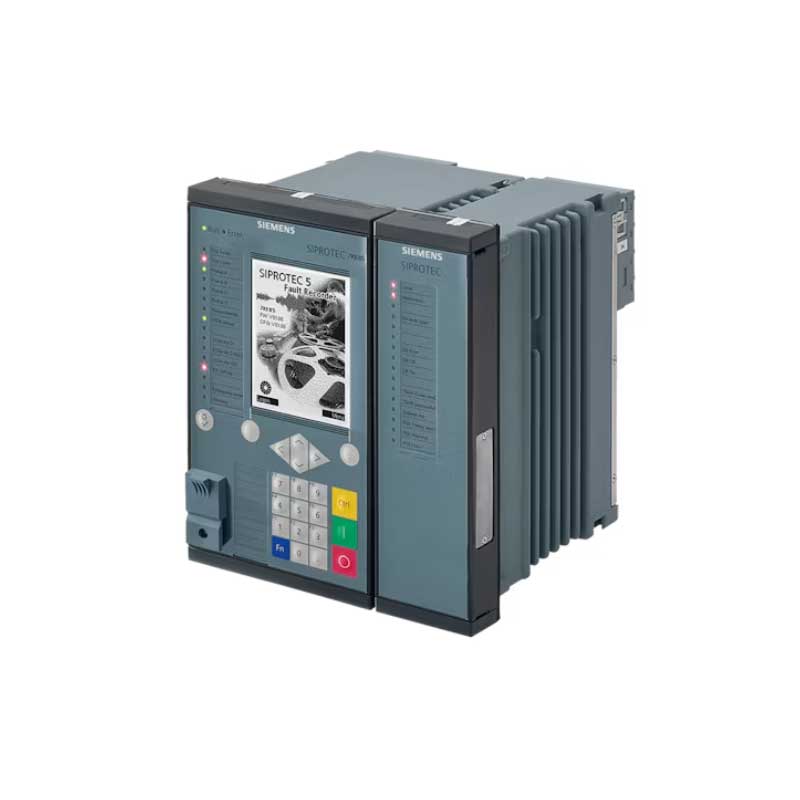
Siemens SIPROTEC 7KE85 Digital Fault Recorder
$785.00
Siemens SIPROTEC 7KE85 Digital Fault Recorder Suppliers,Exporters in India
ARP IMPEX is a supplier and exporter of Siemens SIPROTEC 7KE85 Digital Fault Recorders in India. We handle requirements for power plants, utility substations, transmission networks, industrial power systems, renewable energy projects and replacement of existing fault-recording equipment.
When a power-system fault occurs, protection relays may trip within milliseconds. The disturbance may be cleared quickly, but engineers still need to understand what caused it, how the electrical values changed and whether the protection and circuit breakers operated correctly.
The Siemens SIPROTEC 7KE85 records the current, voltage, frequency, power and binary status signals before, during and after the event. It gives protection engineers the waveform and sequence information needed to investigate short circuits, voltage disturbances, generator behaviour, transformer energisation, power swings and unexpected equipment trips.
The device can run several types of recorders at the same time. High-speed fault recording, continuous recording, slow-scan recording, trend recording, power-quality measurement and sequence-of-events recording can be configured within one system.
Its modular SIPROTEC 5 hardware supports applications ranging from a few current and voltage channels to larger substation arrangements with up to 40 analogue channels. Binary signals such as circuit-breaker positions, protection trips and alarms can be included in the same event record.
The 7KE85 can also work as a Phasor Measurement Unit for synchrophasor applications and as a power-quality recorder for monitoring harmonics, voltage dips, voltage rises and other supply disturbances.
For Siemens SIPROTEC 7KE85 price and availability, send the complete Siemens order code, required channel configuration, quantity and destination country.
What the Siemens 7KE85 Records
The 7KE85 can monitor electrical and equipment signals from several points in a power system.
Depending on the selected input modules, recorded values may include:
- Three-phase currents
- Neutral and ground current
- Three-phase voltages
- Busbar voltages
- Frequency
- Active power
- Reactive power
- Apparent power
- Power factor
- Positive-sequence values
- Negative-sequence values
- Zero-sequence values
- Harmonic measurements
- Circuit-breaker position
- Disconnector position
- Protection relay pickup
- Protection trip signals
- Circuit-breaker trip-coil operation
- Transformer alarms
- Generator alarms
- Equipment status signals
- IEC 61850 GOOSE messages
The recorder can capture pre-fault, fault and post-fault information. This allows engineers to see what happened immediately before the disturbance and how the system responded after the trip.
Fast-Scan Fault Recording
The fast-scan recorder is used for detailed waveform recording during short circuits and other fast electrical disturbances.
The sampling frequency can be selected between approximately 1 kHz and 16 kHz. A higher sampling rate gives more waveform detail but uses more recording memory.
Fast recording is useful for checking:
- Short-circuit current
- Fault inception angle
- Current-transformer saturation
- Voltage collapse
- Circuit-breaker clearing time
- Protection relay operating time
- Trip-circuit performance
- Transformer inrush current
- Generator disturbances
- Power-system oscillations
- Switching transients
- Arc-fault behaviour
The recording can start from an electrical value, binary signal, protection indication, GOOSE message or a manually initiated command.
Slow-Scan Recording
Not every power-system problem happens within a few milliseconds.
Some disturbances develop over several seconds or minutes. These may include:
- Gradual voltage reduction
- Generator instability
- Frequency decline
- Power swings
- Transformer overloading
- Slow process changes
- Increasing current demand
- Renewable generation fluctuations
- Long starting cycles
- Repeated switching activity
The Siemens 7KE85 can provide up to two slow-scan recorders, depending on the configured functional scope.
Slow-scan recording gives a longer view of the event without using the amount of storage required by high-speed waveform recording.
Continuous Recording
The 7KE85 can continuously record selected electrical quantities.
Applicable configurations support up to five continuous recorders. The device keeps recording into its internal storage and replaces the oldest data as the allocated recording space becomes full.
Continuous recording is useful when:
- The cause of a disturbance is not known in advance
- The event does not operate a protection relay
- A condition develops slowly
- Engineers need information from several minutes before an alarm
- The utility wants long-term visibility of system behaviour
- Generator and industrial-process performance must be reviewed
The amount of memory assigned to each recorder can be configured according to the importance of the recorded signals.
Trend Recording
Trend recording is used for long-term observation of measured values rather than detailed waveform analysis.
Applicable configurations support up to two trend recorders.
Trend records may be used to monitor:
- Busbar voltage
- Feeder current
- Transformer loading
- Generator output
- Active and reactive power
- Power factor
- System frequency
- Harmonic levels
- Daily load variation
- Renewable power output
- Industrial demand patterns
These records can help maintenance and operations teams identify gradual changes that may not cause an immediate trip.
Sequence-of-Events Recording
Understanding an electrical fault requires more than current and voltage waveforms. Engineers also need the exact order in which relays, circuit breakers and control signals operated.
The sequence-of-events recorder continuously monitors changes in binary signals and applicable IEC 61850 GOOSE messages.
It can record events such as:
- Protection relay pickup
- Trip command issued
- Circuit-breaker opening
- Circuit-breaker closing
- Breaker-failure initiation
- Automatic reclosing
- Lockout relay operation
- Transformer alarm
- Generator trip
- Busbar protection operation
- Communication alarm
- Control-system command
- Disconnector position change
Accurate time stamps allow engineers to compare these events with the recorded current and voltage waveforms.
This helps determine whether the protection relay operated first, whether the breaker opened within the expected time and whether any backup protection operated unnecessarily.
Flexible Trigger Functions
The 7KE85 does not rely on only one fixed fault trigger.
Recording can be started from:
- Current level
- Voltage level
- Frequency level
- Active-power level
- Reactive-power level
- Apparent-power level
- Rate of change
- Positive-sequence value
- Negative-sequence value
- Zero-sequence value
- Binary input
- Protection indication
- Circuit-breaker position
- IEC 61850 GOOSE message
- Network trigger
- Manual trigger
- Power-swing condition
- A combination of several signals
Different trigger conditions can be created through the DIGSI 5 graphical logic editor.
For example, a recording can be started when the busbar voltage falls below a set value, and the incoming circuit breaker opens. Another recorder may start when the negative-sequence current exceeds its setting or a generator protection relay sends a trip signal.
Each recorder can have its own trigger and storage arrangement.
Power-Quality Recording
The Siemens SIPROTEC 7KE85 can monitor the quality of the electrical supply as well as record faults.
Depending on the selected functions, power-quality monitoring may cover:
- Voltage dips
- Voltage rises
- Voltage interruptions
- Voltage unbalance
- Current unbalance
- Harmonics
- Individual harmonic values
- Total Harmonic Distortion
- Total Demand Distortion
- Frequency variation
- Flicker
- Rapid voltage changes
- Power fluctuations
Power-quality recording is useful when a plant experiences:
- Repeated drive trips
- PLC shutdowns
- Motor overheating
- Transformer heating
- Capacitor-bank failures
- Unexplained equipment resets
- Lighting fluctuation
- Harmonic problems
- Utility supply complaints
- Renewable energy fluctuations
The 7KE85 can help determine whether the disturbance originated from the utility network, the industrial load or another part of the plant.
Phasor Measurement Unit
The Siemens 7KE85 can be configured as a Phasor Measurement Unit according to IEEE C37.118.
A PMU measures the magnitude and phase angle of current and voltage using an accurate common time reference.
When PMUs from several substations are compared, engineers can monitor how the power system behaves across a wide geographical area.
Synchrophasor data may be used for:
- Transmission-network monitoring
- Grid-stability analysis
- Phase-angle monitoring
- Power-oscillation analysis
- Inter-area oscillation monitoring
- Generator stability assessment
- Renewable energy integration
- Wide-area monitoring systems
- Post-disturbance analysis
- System-separation studies
The PMU data can be transmitted to a phasor data concentrator using the IEEE C37.118 protocol.
Technical Specifications
The Siemens SIPROTEC 7KE85 is a configurable product. The final hardware and functions depend on the complete Siemens order code.
- Brand: Siemens
- Product family: SIPROTEC 5
- Model: 7KE85
- Product type: Digital fault recorder
- Main application: Power-system disturbance recording and analysis
- Voltage systems: Medium-voltage, high-voltage and extra-high-voltage
- Analogue channels: Up to 40, depending on configuration
- Binary inputs: Up to approximately 43 in predefined variants
- Binary outputs: Up to approximately 33 in predefined variants
- Fast-scan recorder: Available
- Sampling frequency: Configurable from approximately 1 kHz to 16 kHz
- Slow-scan recorders: Up to two
- Continuous recorders: Up to five
- Trend recorders: Up to two
- Sequence-of-events recorder: Available
- Internal recording buffer: Approximately 16 GB
- Maximum waveform-recording time: Approximately 80 seconds at 8 kHz or 320 seconds at 2 kHz
- Power-quality measurement: According to applicable IEC 61000-4-30 functions
- Harmonic measurement: According to applicable IEC 61000-4-7 functions
- PMU function: IEEE C37.118 option
- Time synchronisation: PTP, IRIG-B, DCF77 and SNTP options
- Engineering software: Siemens DIGSI 5
- Automation logic: Graphical CFC logic editor
- Local display: Small, large or no-display versions
- Mounting: Flush or surface mounting
- Housing: Modular SIPROTEC 5 hardware
- Power supply: Standard or redundant supply options
- Integrated communication: Electrical Ethernet interface
- IEC 61850: Reporting and GOOSE communication
- Ethernet redundancy: PRP, HSR and RSTP options
- Web access: Operational measurements, logs, settings and device information
- Data export: COMTRADE and applicable fault-record formats
- Cybersecurity: Role-based access and network authentication options
- Environmental protection: Conformal-coated electronic boards
- Operating temperature: Extended range on applicable hardware
These are general family specifications. The number of current inputs, voltage inputs, binary inputs, outputs, communication ports and recording functions must be confirmed from the complete Siemens 7KE85 order code.
Communication Options
Depending on the selected communication modules, the Siemens 7KE85 can support:
- IEC 61850 reporting
- IEC 61850 GOOSE
- IEC 61850 process-bus functions
- IEC 60870-5-103
- IEC 60870-5-104
- DNP3 serial
- DNP3 TCP
- Modbus TCP
- PROFINET IO
- IEEE C37.118
- SNMP
- PTP time synchronisation
- SNTP time synchronisation
Electrical and fibre-optic communication modules are available for applicable configurations.
PRP and HSR network redundancy can maintain communication after a single network or connection failure.
The required protocol, connector type, fibre distance, network arrangement and redundancy must be confirmed before selecting the communication hardware.
Fault Record Storage and Retrieval
The Siemens 7KE85 uses an internal recording buffer that can be divided between the different recorder functions.
More storage can be assigned to high-speed fault recording, continuous recording, power-quality recording or trend data according to the project requirement.
Records can be retrieved through:
- DIGSI 5
- Device web interface
- Station communication network
- IEC 61850 communication
- Automatic record-transfer system
- Central fault-analysis software
Loss-free data compression helps use the available storage efficiently.
Automatic collection can reduce the need for an engineer to visit the substation after every fault.
Typical Events Recorded by the 7KE85
Short Circuits
The recorder captures current and voltage waveforms during phase faults, ground faults and three-phase short circuits.
Engineers can use the record to check:
- Fault-current magnitude
- Fault duration
- Protection pickup
- Relay operating time
- Breaker clearing time
- CT saturation
- Voltage recovery
Transformer Energisation
When a transformer is energised, it can draw a high magnetising inrush current.
The 7KE85 can record the inrush waveform, harmonic content, voltage behaviour and breaker-closing sequence.
This helps separate normal transformer inrush from an internal transformer fault.
Generator Disturbances
The recorder can monitor:
- Generator current
- Generator voltage
- Frequency
- Active and reactive power
- Power swings
- Loss of generation
- Load rejection
- Generator synchronisation
- Turbine trip
- Generator protection operation
These records can help investigate generator trips and power-plant disturbances.
Voltage Dips and Interruptions
A short voltage dip may trip drives, contactors and automation equipment even when no protection relay operates.
The 7KE85 can record the depth, duration and affected phases of the voltage disturbance.
This helps determine whether the problem came from the incoming utility supply, a nearby short circuit or an internal plant load.
Power Swings
Power swings can occur after generator trips, major transmission faults or sudden changes in power flow.
The recorder can capture the changing voltage, current, frequency, active power and phase relationship during the oscillation.
This information is useful for grid-stability and protection-setting studies.
Features
- Dedicated digital fault-recording platform
- Suitable for medium- to extra-high-voltage systems
- Supports up to 40 analogue channels
- Records current, voltage, power and frequency values
- Fast-scan recording with adjustable sampling rate
- Up to two slow-scan recorders
- Up to five continuous recorders
- Up to two trend recorders
- Continuous sequence-of-events recording
- Several recorder functions can operate at the same time
- Separate trigger conditions can be assigned to each recorder
- Level and rate-of-change triggers are available
- Binary, analogue and GOOSE signals can start recording
- Integrated power-quality recording
- Harmonic, THD and TDD measurement options
- PMU function according to IEEE C37.118
- Large internal recording buffer
- Configurable storage allocation
- Loss-free data compression
- Accurate time synchronisation
- IEC 61850 communication
- PRP and HSR network redundancy
- Modular current, voltage and binary I/O
- Standard or redundant auxiliary supply
- Local display options
- Web-based access to records and measurements
- DIGSI 5 engineering and commissioning
- Graphical logic editor for custom trigger conditions
- Suitable for centralised fault-recording systems
- Conformal-coated boards suit harsh substation environments
- Role-based access supports controlled operation
- Suitable for new installations and fault-recorder replacement
Applications
Siemens SIPROTEC 7KE85 Digital Fault Recorders are used in:
- Transmission substations
- Distribution substations
- High-voltage substations
- Extra-high-voltage substations
- Thermal power plants
- Combined-cycle power plants
- Hydro power stations
- Captive power plants
- Generator switchyards
- Transformer bays
- Transmission-line bays
- Busbar systems
- Grid interconnection substations
- Renewable energy substations
- Solar power plants
- Wind-farm substations
- Battery energy storage systems
- Industrial power systems
- Steel plants
- Cement plants
- Refineries
- Petrochemical facilities
- Oil and gas plants
- Mining operations
- Fertiliser plants
- Chemical processing units
- Pulp and paper mills
- Railway traction substations
- Data-centre power systems
- Semiconductor manufacturing facilities
- Water and desalination plants
- Marine and offshore installations
- Power-quality monitoring systems
- Wide-area monitoring systems
- Substation modernisation projects
- Replacement of older digital fault recorders
Use in Power Plants
Power plants contain several electrical systems that must operate together during normal and fault conditions.
The Siemens 7KE85 can record:
- Generator output
- Generator transformer current
- Busbar voltage
- Auxiliary transformer loading
- Generator circuit-breaker operation
- Turbine trip signals
- Generator protection trips
- Grid disturbances
- Station auxiliary supply
- Power swings
- Load rejection
- Synchronising events
A single disturbance may involve the turbine, generator, transformer, switchyard and utility network.
By recording electrical and binary signals from these areas with a common time reference, the 7KE85 helps engineers reconstruct the complete event.
Use in Transmission Substations
Transmission faults may be cleared within a few cycles, leaving limited information for operators.
The Siemens 7KE85 can record current and voltage from several line, transformer or busbar bays.
It can also record protection trips, circuit-breaker positions and IEC 61850 GOOSE messages.
This helps utilities review:
- Distance protection operation
- Line differential protection operation
- Busbar protection trips
- Circuit-breaker failure
- Automatic reclosing
- Power swings
- Transmission-line faults
- Grid-separation events
- System frequency disturbances
The PMU option can provide additional synchrophasor information for wide-area monitoring.
Use in Industrial Power Systems
Industrial plants may experience disturbances that do not create a permanent electrical fault but still stop production.
Examples include:
- Voltage dips
- Brief interruptions
- Motor starting problems
- Transformer inrush
- Harmonic distortion
- Drive trips
- Generator instability
- Utility supply disturbances
- Incorrect circuit-breaker operation
- Protection relay maloperation
The 7KE85 records the electrical values and equipment status needed to find the origin of the disturbance.
Plants searching for a Siemens 7KE85 fault recorder for refineries, steel plants, cement plants or petrochemical facilities should provide the required current and voltage channels, binary-signal quantity and communication requirement.
Siemens 7KE85 and a Protection Relay Difference
The Siemens SIPROTEC 7KE85 is not normally used as the main protection relay for a feeder, transformer, generator or transmission line.
A protection relay measures the electrical system, detects a fault and sends a trip command to the circuit breaker.
The basic difference is:
- Protection relay: Detects the fault and initiates tripping
- Siemens 7KE85: Records the electrical waveforms and operating sequence for later analysis
The 7KE85 can receive signals from several protection relays and circuit breakers. It then places all the information into one time-aligned record.
This allows engineers to check whether the protection system operated correctly.
Siemens 7KE85 and Relay Disturbance Record Difference
Most numerical protection relays include a disturbance recorder, but the number of analogue channels, recording time and storage are normally centred on that relay’s own protection zone.
The Siemens 7KE85 is a dedicated fault-recording system.
It can:
- Monitor more analogue channels
- Collect signals from several protection zones
- Run several recorder types simultaneously
- Store longer and continuous recordings
- Record extensive binary and GOOSE information
- Carry out power-quality recording
- Work as a PMU
- Provide centralised disturbance records for a substation or plant
A protection relay disturbance record may be sufficient for one feeder fault. The 7KE85 is more suitable where engineers need a wider view of the complete substation or power-system event.
Selecting the Correct Siemens SIPROTEC 7KE85
The model name 7KE85 does not identify one fixed hardware configuration.
The complete Siemens order code defines the measuring inputs, binary I/O, housing, display, auxiliary supply, communication modules and recording functions.
For an accurate quotation, provide:
- Complete Siemens 7KE85 order code
- Required quantity
- Destination country
- System voltage
- System frequency
- Number of current channels
- Number of voltage channels
- Number of binary inputs
- Number of binary outputs
- CT secondary rating
- VT secondary rating
- Required sampling frequency
- Required recording duration
- Fast-scan recorder requirement
- Slow-scan recorder requirement
- Continuous recorder requirement
- Trend recorder requirement
- Power-quality requirement
- PMU requirement
- Sequence-of-events requirement
- IEC 61850 requirement
- Required communication protocol
- Fibre-optic or electrical interfaces
- PRP or HSR redundancy requirement
- Time-synchronisation method
- Display requirement
- Flush or surface mounting
- Auxiliary supply voltage
- Standard or redundant power supply
- Existing DIGSI 5 project file, where available
For replacement enquiries, send clear photographs of the existing device label, front panel, rear modules and terminal arrangement.
Siemens SIPROTEC 7KE85 Replacement
For replacement of an existing Siemens 7KE85 Fault Recorder, share:
- Full order code
- Serial number
- Firmware version
- DIGSI 5 configuration file
- Front and rear photographs
- Current and voltage input details
- Binary I/O details
- Communication-module details
- Existing network settings
- Time-synchronisation arrangement
- Auxiliary supply voltage
- Required quantity
- Destination country
A replacement device must match the physical inputs and outputs as well as the recorder and communication configuration.
Two Siemens 7KE85 units may look the same from the front but have different measuring modules, communication cards and activated functions.
Siemens SIPROTEC 7KE85 Supplier and Exporter in India
ARP IMPEX supplies Siemens SIPROTEC 7KE85 Digital Fault Recorders for utilities, power plants, EPC contractors, transmission substations, industrial plants, protection engineers, panel builders and export buyers.
We handle enquiries for Siemens 7KE85 power-system fault recorders, digital disturbance recorders, power-quality recorders, PMU devices, IEC 61850 fault-recording systems and replacement of existing Siemens SIPROTEC 7KE85 units.
Buyers searching for Siemens SIPROTEC 7KE85 price in India, Siemens fault recorder supplier, Siemens digital disturbance recorder exporter from India or Siemens 7KE85 replacement can send the complete order code for review.
The Siemens 7KE85 price depends on the number of current and voltage channels, binary I/O, housing, display, power supply, recording functions, PMU option, power-quality functions and communication modules.
Send the complete Siemens order code, required quantity and destination country for price, availability and export quotation.
Related products
-
Legrand RTX3 40 Thermal Overload Relay 6 to 9 A (For CTX3 22 and 40) 416650
-
Legrand RTX3 40 Thermal Overload Relay 0.4 to 0.63 A (For CTX3 22 and 40) 416643
-
Legrand RTX3 40 Thermal Overload Relay 22 to 32 A (For CTX3 22 and 40) 416656
-
Legrand RTX3 40 Thermal Overload Relay 0.16 to 0.25 A (For CTX3 22 and 40) 416641